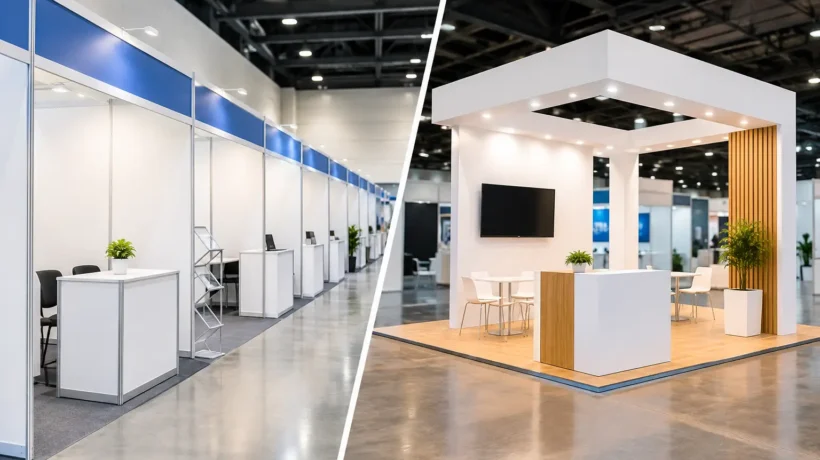
A 10-by-10 inline space can deliver a focused, productive sales environment. A 20-by-20 island can create the visual center of a show floor. The better choice is not automatically the larger one. When comparing inline booths versus island booths, the right footprint depends on what the event needs to accomplish, how attendees move through the hall, and what your team can realistically support.
Floor space sets the conditions for every decision that follows: sightlines, messaging, staffing, lead capture, storage, budget, and logistics. A well-planned inline booth can outperform an oversized island if its story is clear and its audience is specific. At the same time, a brand with a major launch or a crowded event category may need the access and presence that only an island can provide.
Inline Booths Versus Island Booths: The Core Difference
An inline booth, sometimes called a linear booth, sits in a row with neighboring exhibitors on both sides. It typically has one open side facing the aisle and a back wall that serves as the primary branding and messaging surface. Standard inline spaces are often 10-by-10 or 10-by-20 feet, although show rules and configurations vary.
An island booth is surrounded by aisles on all four sides. It is generally larger, commonly 20-by-20 feet or more, and it gives attendees multiple ways to enter and engage. Because it has no neighboring booths defining its edges, an island environment can support taller structures, more dimensional design, demonstration zones, meeting areas, and experiences that reward exploration.
The difference is not simply square footage. An inline booth asks your brand to make a strong case from one direction. An island booth asks you to create a coherent experience from every direction.
When an Inline Booth Is the Smarter Investment
Inline exhibits work especially well when your goal is to establish a polished presence, qualify leads, support a sales team, or participate consistently across several events. Their more contained footprint helps teams control costs while keeping the visitor journey simple: attract attention, communicate value quickly, begin a conversation, and capture the next step.
The back wall is the strategic center of an inline design. It should not become a catalog of every service, product, and company milestone. From across the aisle, attendees need to understand what you do and why it matters in seconds. A concise message, a memorable graphic concept, and intentional lighting can make a modest footprint feel highly considered.
Inline spaces can also be operationally efficient. There is less flooring to manage, fewer surfaces to clean, and typically fewer staffing positions to cover. For organizations with a lean field marketing team or a packed event calendar, those advantages matter. A rental display system with custom graphics can create a tailored look without requiring a long-term commitment to a large owned exhibit.
That does not mean inline booths are automatically inexpensive. Premium graphics, high-quality lighting, integrated technology, custom storage, and elevated finishes can raise the investment. Still, the total program cost is usually easier to contain because the exhibit has a smaller physical and logistical footprint.
The limitations to plan around
The main constraint is access. Visitors enter from one aisle, so congestion can develop quickly when a product demonstration or popular meeting is underway. The booth can also feel closed if the front edge is packed with furniture, counters, or staff.
Height restrictions may limit how far your brand can reach above the show floor, particularly compared with an island display. And because neighboring exhibitors are close, their design, noise, and traffic patterns can affect your environment. Strong pre-show planning, including a review of the floor plan and adjacent companies, helps prevent surprises.
When an Island Booth Earns Its Footprint
Island booths are built for brands that need more room to be seen, experienced, and remembered. They are well suited for product launches, live demonstrations, hospitality, executive meetings, immersive storytelling, and high-traffic events where competitors are investing heavily in presence.
Four open sides create more opportunities to attract attendees, but they also demand more design discipline. There is no back wall to carry the entire message. Your identity, value proposition, and visual language need to work at multiple distances and from every approach. High-level branding may need to be visible across the hall, while product details and conversation areas need to feel clear at ground level.
The additional space lets you separate functions without making the booth feel crowded. A technology company, for example, might use one zone for quick product introductions, another for hands-on demos, a semi-private area for qualified conversations, and a storage area that keeps supplies out of sight. This can improve the attendee experience and help staff move leads through a more deliberate engagement path.
An island can also create a stronger sense of destination. Architectural form, suspended elements where permitted, layered lighting, digital content, and hospitality can turn a booth into a branded environment rather than a display. That presence can be valuable when awareness is an explicit event objective, not just a byproduct of lead generation.
The added demands of an island exhibit
Greater visibility comes with greater responsibility. An island booth requires a larger investment in space, design, fabrication or rental components, electrical planning, freight, installation and dismantle, and staffing. It often needs more detailed coordination with the show organizer, general contractor, and venue requirements.
Staffing is frequently underestimated. Four open sides mean visitors can approach from anywhere, often at the same time. A spacious booth with too few trained team members can feel unattended, while a crowd of staff standing at the perimeter can make it difficult for attendees to enter. The staffing plan should be designed alongside the floor plan, not after it.
Storage deserves early attention as well. Samples, literature, personal items, cleaning supplies, technology cases, and refreshments still need a home. If storage is not integrated into the environment, the operational clutter can dilute the very premium impression the island booth was intended to create.
Compare the Decision Through Event Objectives
The most useful question is not, “Which booth type looks better?” It is, “What must this event produce?” A company attending a regional show to support existing accounts may get better returns from a sharp 10-by-20 inline booth and a well-prepared sales team than from a large island space. The money saved can support pre-show outreach, post-show follow-up, travel, or participation in additional markets.
An island may be the better choice when the event is a strategic moment for the business. Perhaps you are introducing a complex product that needs live demonstration, entering a new market, hosting scheduled customer meetings, or competing for attention in a hall filled with major industry players. In those situations, the footprint can support a broader campaign rather than simply occupying floor space.
Consider these practical factors together:
- Traffic and location: An inline booth on a main aisle near a relevant destination may have stronger traffic than an island positioned in a quiet corner.
- Message complexity: A simple, direct offer can thrive in an inline format. Multiple products, demonstrations, or audience segments may need an island’s zoning flexibility.
- Event frequency: A modular inline exhibit can travel efficiently across a busy calendar. A larger island may make sense for anchor events supported by smaller programs elsewhere.
- Lead strategy: If the goal is rapid qualification, a compact layout can keep conversations moving. If the goal is deeper consultation, an island can offer distinct spaces for different stages of the conversation.
- Internal capacity: Bigger environments require more coordination before, during, and after the event. Turnkey management can reduce that burden, but the workload should be accounted for from the start.
Design Principles That Apply to Both
Whether the footprint is 100 square feet or 1,000, the exhibit should have a clear job. Every physical choice should support the desired attendee action: notice the brand, understand the offer, watch a demo, schedule a meeting, or speak with a specialist.
Start with the visitor’s first five seconds. What can they see from the aisle? What makes the brand distinct? What is the natural invitation to step closer? Then design the next layer of information for the people who enter. This hierarchy prevents a common mistake: trying to communicate everything at once.
Plan for the real conditions of the show floor. Screens need the right viewing angles and brightness. Product demos need power, connectivity, and enough room for a small audience. Meeting areas need to balance privacy with approachability. Graphics need to remain legible amid motion, noise, and competing visual messages.
FrontLine Exhibits approaches these details as part of one coordinated environment, because creative impact only works when the logistics, staffing needs, installation plan, and daily use of the space have been considered too.
Choose the Presence You Can Fully Activate
A small booth with a confident message, trained staff, and disciplined follow-up is not a lesser version of a large exhibit. It is a different strategic tool. Likewise, an island booth should be more than a larger structure. It should give your team new ways to demonstrate value, host meaningful conversations, and create momentum around the brand.
Before reserving space, picture the booth at its busiest moment. Can attendees understand where to go? Can your team greet and guide them? Can the environment support the conversations that matter most? The best footprint is the one your organization can fully activate, manage confidently, and turn into measurable progress long after the show floor closes.