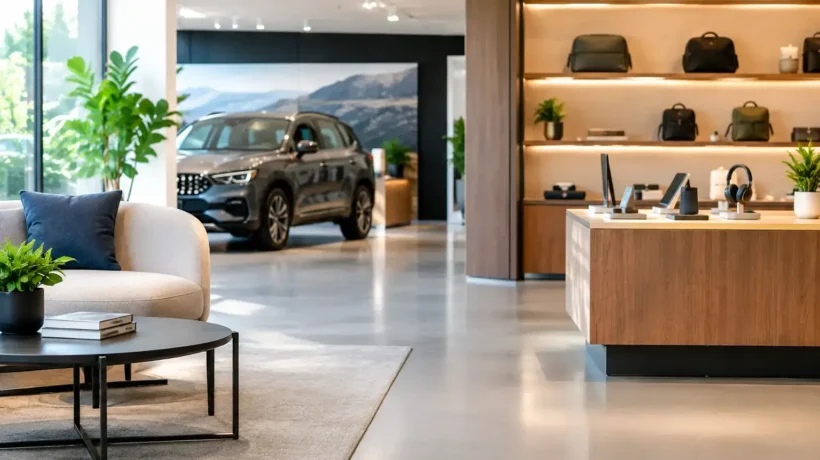
A showroom should do more than hold products. The strongest branded showroom examples give visitors a reason to stay, help sales teams lead better conversations, and make a company’s value easier to understand at a glance. They turn a physical space into a working business tool – one built around how customers evaluate, compare, ask questions, and decide.
For B2B organizations, that distinction matters. A polished environment can create confidence, but only if the layout, storytelling, graphics, and operational details support the sales process. The following examples show how different showroom strategies can create meaningful presence without treating every project as the same kind of display.
What makes a showroom feel truly branded?
A branded showroom is not defined by a logo on the wall or a matching color palette alone. It is a place where the visual environment, product story, visitor path, and staff experience all reinforce the same promise. A visitor should be able to understand what the company does, who it serves, and why its offer is worth considering before the first formal presentation begins.
The right approach depends on the product, audience, sales cycle, and footprint. A technical manufacturer may need hands-on demonstration stations and comparison tools. A professional services firm may need a hospitality-forward briefing center that makes complex capabilities feel tangible. A retailer may need flexible vignettes that can change with seasonal campaigns. Strategic design begins with those requirements, not a standard floor plan.
7 branded showroom examples worth studying
1. The product-in-use environment
Rather than lining products against a wall, this showroom places them in a realistic setting. Think of commercial fixtures installed in a hospitality, healthcare, or workplace vignette, or building materials shown within an architectural room scene. Visitors can see scale, finish, function, and context at the same time.
This approach is especially effective when a product’s value is difficult to explain in a catalog. It turns abstract specifications into an immediate experience. The trade-off is space: realistic scenes require a larger footprint and careful maintenance, so they are best reserved for products where context directly affects purchase confidence.
2. The guided product journey
Some offerings make more sense in sequence. A showroom for a technology platform, industrial system, or financial service can guide visitors through a clear narrative: the customer challenge, the process, the solution, and the result. Large-scale graphics establish the story while interactive displays, models, or short demonstrations add depth at key points.
The design goal is not to force every visitor through a rigid path. It is to give sales teams a reliable framework for adapting the conversation. An executive may want the business case first, while an operations lead may head directly to implementation details. A well-planned journey provides both without becoming visually crowded.
3. The working demonstration lab
For complex products, credibility often comes from proof. A demonstration lab gives visitors a chance to see equipment, software, materials, or systems perform under realistic conditions. Clean sightlines, accessible controls, durable finishes, and thoughtful cable management matter as much as the dramatic focal point.
This is one of the most powerful branded showroom examples for companies whose sales process depends on technical validation. It also asks more of the organization. Staff need training, demonstrations need consistent upkeep, and the room must safely accommodate repeated use. The investment pays off when a live experience shortens the distance between interest and trust.
4. The solutions gallery
A solutions gallery organizes the space around customer industries, applications, or challenges instead of individual product lines. For example, a manufacturer with a broad portfolio might create dedicated zones for education, government, healthcare, and commercial clients. Each zone shows a focused combination of products, messaging, project imagery, and relevant outcomes.
This format helps visitors recognize themselves in the environment. It is also useful for cross-selling because it shows how separate products work together as a complete solution. The risk is repetition. If every zone uses the same message structure and visual treatment, the experience can feel generic. Each area needs a distinct point of view while still belonging to the larger brand system.
5. The hospitality-led briefing center
Not every showroom needs a dense product display. For consultative B2B sales, a hospitality-led briefing center may be more effective. It can include a welcoming reception area, comfortable conversation settings, a presentation room, material samples, and carefully selected proof points that support a deeper discussion.
The atmosphere should feel intentional, not decorative. Comfortable seating, lighting, refreshments, acoustics, and technology all affect whether visitors can focus and whether teams can host with confidence. This model works well when the sale involves multiple stakeholders and a longer decision process. It may be less suitable for businesses that need to demonstrate a wide physical product range on the spot.
6. The flexible campaign showroom
A flexible showroom is designed to change. Modular walls, interchangeable graphics, adaptable lighting, digital displays, and mobile furniture allow a company to refresh the space for product launches, seasonal priorities, partner events, or visiting customer groups. The underlying architecture remains recognizable while the message stays current.
Flexibility can protect a long-term investment, especially for companies with evolving product lines or frequent marketing campaigns. However, modularity should not become an excuse for a temporary-looking environment. The permanent elements still need to establish a strong brand presence, and updates need clear ownership so the space does not slowly collect outdated materials.
7. The showroom that extends beyond its walls
The most useful showroom can support activity before and after a visit. This might mean a content-capture area for product videos, an event-ready presentation zone, a private meeting room for account conversations, or a small training area for dealers and internal teams. The showroom becomes a hub for marketing, sales enablement, and relationship building rather than an occasional destination.
This model can increase the return on a physical environment because the space works harder throughout the year. It requires planning across departments. Marketing, sales, operations, and facilities need aligned expectations about scheduling, visitor protocols, technology, and asset updates. When those details are managed early, the showroom can support far more than a single type of interaction.
Design around decisions, not just displays
The most effective branded showrooms begin with questions that are more commercial than decorative. What must a first-time visitor understand within the first minute? Which products or proof points move the conversation forward? Where do sales teams need privacy? What needs to be updated regularly, and who will manage it?
Those answers shape the physical plan. A central feature wall may establish the big idea, while smaller zones allow for specific conversations. Product samples may belong near a consultation table rather than behind glass. Digital content can be valuable, but only when it provides information visitors cannot get more easily from a printed panel or a knowledgeable representative.
Operational planning deserves equal attention. Inventory, cleaning, replacement graphics, demonstration readiness, visitor flow, accessibility, power, storage, and staff training all influence the experience. A beautiful space that is hard to reset before a customer visit creates pressure for the very team it was meant to support.
Build a showroom that can keep working
A showroom is a long-term brand asset, but it should not be treated as permanent in every detail. Establish durable brand elements, then plan for controlled change through replaceable graphics, flexible fixtures, and an organized asset system. This makes it easier to respond to new products, fresh case studies, and shifting market priorities without starting from scratch.
For organizations managing multiple environments, a partner such as FrontLine Exhibits can bring design, production, logistics, and ongoing support into one coordinated process. That coordination matters when the project includes custom structures, branded graphics, technology, stored assets, or a compressed opening timeline.
The best next step is not choosing finishes or fixtures. It is identifying the moment when a visitor should think, “This company understands my problem.” Build the showroom around creating that moment clearly, confidently, and often.