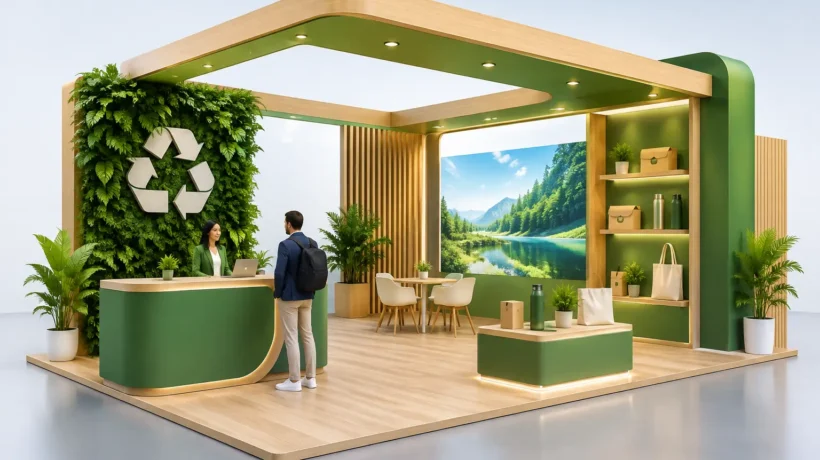
A trade show booth can create a powerful first impression for three days, then become an expensive storage problem for three years. Sustainable exhibits change that equation. They are not simply displays made from recycled materials. They are branded environments designed to create meaningful presence now, while remaining useful, adaptable, and manageable after the event floor closes.
For marketing and event teams, the value is practical as much as environmental. A well-planned exhibit can reduce one-time production, avoid rushed replacement costs, simplify shipping, and give your team more flexibility across a busy event calendar. The goal is not to make every exhibit smaller or less ambitious. It is to apply imagination strategically, so every component has a clear job before, during, and after the show.
Sustainable Exhibits Begin With a Better Brief
The most consequential sustainability decisions happen before design concepts take shape. If the brief only asks for a visually striking 20-by-20 booth for a single event, the resulting environment will likely be optimized for that one footprint, one audience, and one deadline. If the brief asks how the exhibit will serve a campaign across several markets, the conversation becomes more valuable.
Start with the business purpose. Is the exhibit built to launch a product, support sales appointments, demonstrate equipment, recruit talent, or increase brand awareness? What must visitors see, touch, or understand? Those answers help determine which elements deserve investment and which can remain flexible.
A useful planning conversation also looks ahead. Consider the number of expected events, possible booth sizes, shipping distances, storage conditions, and the likelihood of message changes. A national event program may justify a durable custom structure with interchangeable graphics. A company exhibiting once or twice a year may be better served by a high-impact rental environment tailored to the event rather than purchasing assets that sit idle.
Sustainability is not a single material choice. It is a decision framework that weighs longevity, reuse, transport, labor, visual impact, and budget together.
Design for Reuse, Not Just One Appearance
The strongest exhibit programs separate long-term structural assets from short-term campaign content. Architectural frames, counters, storage, lightboxes, flooring systems, and hospitality features can be designed for repeated use. Graphics, digital content, product messaging, and select branded moments can change as the campaign evolves.
This approach protects the exhibit from becoming dated the moment a marketing message shifts. Rather than retiring an entire environment because a product line changes color or a new value proposition needs attention, teams can refresh targeted components. The booth remains recognizable while the story stays current.
Modularity matters here, but it should not mean generic. A modular system can still feel distinctly branded when the design accounts for proportion, material finish, visitor flow, lighting, and purposeful graphics. The question is whether components can be reconfigured without making the booth look like a collection of unrelated parts.
For example, a 20-by-20 environment might be planned to divide into a 10-by-20 configuration for regional shows, with a smaller branded footprint available for tabletop or recruiting events. This requires careful planning for sightlines, electrical needs, storage, and graphics placement. It also creates a program with more ways to earn back its investment.
Choose Materials With the Full Lifecycle in Mind
Material selection deserves attention, but a sustainable decision is rarely as simple as choosing the item with the greenest label. A lightweight material that ships efficiently may be the better fit for a frequently traveling exhibit. A heavier, highly durable component may make sense for a corporate lobby or retail installation expected to remain in place for years.
When evaluating exhibit materials, ask practical questions. Can the component be repaired if damaged? Can it be refinished, re-skinned, or repurposed? Is it durable enough for repeated installation? Does it pack efficiently? What happens when it reaches the end of its useful life?
Fabric graphics, for instance, can be lighter to ship and easier to update than rigid panels in some applications. Rigid graphics may be appropriate where durability, texture, or product display requirements call for them. The best choice depends on the environment, event schedule, brand aesthetic, and handling demands.
Avoid treating sustainable materials as a substitute for good design discipline. A display made from recycled content still creates unnecessary waste if it is built for one event, difficult to pack, and impossible to adapt. Conversely, a conventional material may be a responsible choice when it enables years of dependable reuse.
Reduce Freight Without Reducing Presence
Freight is one of the largest operational considerations in an exhibit program. Large, heavy, or awkwardly packed assets can increase cost, complicate logistics, and add unnecessary resource use. Designing with shipment dimensions and installation realities in mind can make a measurable difference.
That does not mean every exhibit must be ultralight. It means weight and volume should support the outcome. A product demonstration may require substantial equipment, secure enclosures, or structural support. In that case, reducing waste may come from designing reusable crating, consolidating shipments, and avoiding disposable build-outs around the product.
Reusable crates deserve particular attention. Properly designed packaging protects assets, speeds inventory checks, and reduces damage during transport. When crates are clearly labeled and configured around the exhibit’s components, the show site becomes easier to manage for both internal teams and installation crews.
Digital content can also reduce the need to print extensive campaign messaging, but screens are not automatically the more sustainable option. They require power, transport protection, setup time, and content management. Use them where motion, demonstration, personalization, or frequent updates add real value. A screen used only to display a static headline may not be the most effective choice.
Build an Asset Management Plan Into the Program
An exhibit does not stay sustainable by design alone. It needs management after each event. Without a clear process for inventory, condition reporting, graphic storage, repair, and future allocation, reusable assets can disappear into warehouses or return damaged without anyone knowing what needs attention.
A managed program creates visibility. After every event, the team should know what was used, what was damaged, what can be refreshed, and what is scheduled for the next show. That information prevents unnecessary reorders and helps marketing teams plan campaigns with confidence.
This is where operational support has a direct effect on sustainability. FrontLine Exhibits approaches asset management as part of the brand environment, not as an afterthought. When exhibits, graphics, crates, and supporting materials are organized around future use, a company can protect its investment while reducing the administrative burden on its event team.
Storage decisions matter as well. A carefully designed asset is only reusable if it is stored in conditions that preserve graphics, hardware, and technology. It may be worth consolidating assets with a partner that can inspect and prepare them between events rather than relying on fragmented storage arrangements and last-minute discovery.
Measure What Matters to Your Program
Not every organization needs a formal environmental reporting model for its exhibit program. But every organization can track a few indicators that reveal whether its approach is improving.
Useful measures include the percentage of exhibit components reused across events, the number of graphics refreshed rather than fully rebuilt, freight weight or shipment count per event, storage utilization, damage rates, and the amount of material diverted from disposal through repurposing or recycling. Pair these measures with commercial outcomes such as qualified leads, meetings held, product demonstrations, and cost per event.
This balance is essential. An exhibit program that reduces materials but fails to attract the right visitors is not a strategic success. Likewise, an impressive booth that requires complete replacement for every event carries costs that may eventually limit the program’s reach. The strongest approach advances brand visibility and operational efficiency at the same time.
Know When Rental Is the More Responsible Choice
Ownership is not always the sustainable answer. For infrequent exhibitors, organizations testing a new market, or teams facing an unusual booth size, renting can prevent underused assets from being produced and stored indefinitely. A thoughtfully selected rental environment can still be customized through graphics, product presentation, lighting, and visitor experience.
The trade-off is control. A fully custom owned exhibit can be built around very specific brand and functional requirements, while a rental program works within available structures and event timelines. Yet for many companies, that flexibility is precisely the advantage. The right rental strategy can provide premium visual impact without creating a long-term asset obligation that does not match the event calendar.
A sustainable exhibit program is ultimately one that respects the full reality of exhibiting: the audience experience, the sales objective, the budget, the freight plan, the labor schedule, and the life of every asset after the show. When those details are considered together, sustainability becomes less of a claim and more of a smarter way to build a brand presence that keeps working.