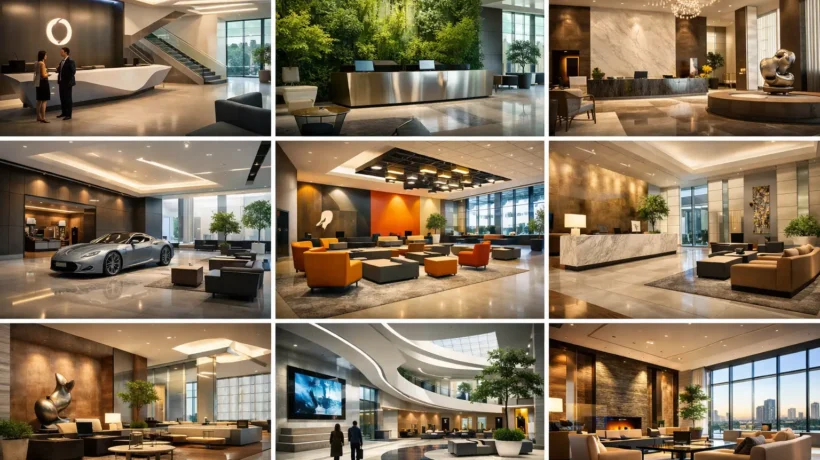
A lobby has only a few seconds to answer the questions every visitor brings through the front door: Who are these people? What do they value? Am I in the right place? The strongest corporate lobby examples do not answer with a logo on a blank wall. They create a clear, useful, and memorable first encounter with the brand while supporting the daily realities of reception, security, meetings, and employee traffic.
For marketing and facilities teams, that balance is where the real work begins. A lobby must carry brand presence without becoming a static showroom, accommodate changing messages without creating constant maintenance, and feel polished without slowing down the people who use it every day. Strategically applied imagination turns those competing requirements into an environment that works.
What a Corporate Lobby Needs to Do
A corporate lobby is not simply an interior design project. It is a business environment with several jobs happening at once. It welcomes prospects, supports visitors, reassures candidates, gives employees a sense of place, and can reinforce the confidence of partners, investors, and vendors.
That does not mean every lobby needs a large digital display or museum-scale installation. The right solution depends on the organization, visitor volume, building constraints, budget, and how often the brand story needs to change. A financial firm may need discretion and calm. A technology company may want to demonstrate momentum and innovation. A manufacturer may need to make complex products tangible.
The following concepts show how corporate lobby design can make brand expression more functional, not more complicated.
1. The Dimensional Brand Story Wall
A dimensional brand wall gives a logo, mission, and visual system more physical authority than a flat graphic alone. It might combine layered letters, textured panels, integrated lighting, materials that reflect the organization’s work, and concise messaging about what the company does.
This approach is particularly effective for professional services firms, headquarters, and organizations whose visitors need a quick orientation. The key is restraint. A wall crowded with every service line, value statement, and milestone becomes difficult to read from the reception area. Prioritize one central message, then use supporting details that reward a closer look.
Operational details matter here. Specify durable finishes that can withstand routine cleaning, place lighting where it will not create glare at the reception desk, and ensure the installation works with wall conditions and building regulations. A statement wall should be designed for its full service life, not just its reveal day.
2. The Product and Proof Display
For companies that make physical products, a lobby can provide evidence, not just claims. An equipment manufacturer might show a precision component alongside an explanation of its role in the field. A consumer brand might present a curated product evolution. A construction, engineering, or materials company may use samples that invite visitors to see and touch what the business delivers.
The most successful product displays are edited like a gallery. They feature a small number of meaningful objects with enough space to command attention. Too many samples can feel like storage, and labels written in technical language can exclude visitors who are not industry experts.
Plan for access from the beginning. Products may need cleaning, security, replacement, or periodic rotation. Locked cases, concealed storage, durable mounts, and a clear refresh process protect the investment and reduce the burden on internal teams.
3. The Living Timeline
A company timeline can be compelling when it is less about dates and more about progress. Instead of listing every anniversary, organize the story around turning points: a foundational idea, a defining project, an expansion, a breakthrough, or a commitment that shaped the company’s direction.
This is one of the most versatile corporate lobby examples for established organizations, family businesses, and brands that need to communicate credibility quickly. It works well along a corridor leading to conference rooms, where visitors can take in the story as they move through the space.
A timeline should also leave room for the future. Use modular panels, replaceable graphics, or a digital element for milestones that will change. That preserves the design while preventing an otherwise impressive installation from becoming outdated.
4. The Community Impact Installation
Many organizations have a genuine local footprint, but their lobbies say little about it. A community impact installation can show the people, partnerships, volunteer efforts, and outcomes connected to the company’s work. For organizations recruiting talent or hosting client meetings, this can give abstract values a visible form.
The message must be specific to earn trust. Generic language about making a difference has limited impact. Real project photography, concise statistics, employee stories, or visual references to local initiatives make the installation more credible and more human.
This concept is especially useful when community programming changes throughout the year. A planned graphics system allows the organization to recognize new partnerships or campaigns without rebuilding the entire lobby environment.
5. The Digital Welcome and Content Hub
Digital displays can make a lobby responsive. They can welcome scheduled visitors, feature current campaigns, share company news, display event content, or communicate practical information such as meeting locations. For multi-location organizations, they can also create consistency across offices.
But screens are not automatically engaging. A large display showing an outdated slide deck can weaken the impression it was meant to create. Before selecting hardware, decide who owns content, how frequently it will be updated, what templates are required, and what happens when the screen is not actively in use.
A strong digital hub pairs motion with a clear content plan. It may use short video, animated data, product visuals, and branded messages, supported by a schedule that makes updates manageable. The goal is to add relevance, not create another channel that staff must constantly feed.
6. The Local Landmark Concept
A corporate lobby can connect a national or global brand to its immediate place. This might involve an abstracted skyline, regional materials, a map-based graphic, local photography, or an artful interpretation of the industry and community the organization serves.
For companies with offices in Richmond, Northern Virginia, Washington, D.C., Baltimore, Virginia Beach, or South Florida, this approach can make a standardized brand system feel rooted rather than generic. It also gives visiting clients and candidates a visual cue that the organization understands its market.
The trade-off is longevity. Literal city imagery can date quickly or feel decorative if it has no relationship to the business. Use local references as part of the brand narrative, not as background scenery.
7. The Culture and Recognition Gallery
Employees notice the lobby too. A recognition gallery can highlight team milestones, patents, awards, customer achievements, safety performance, or employee-led initiatives. Done well, it reinforces culture without feeling self-congratulatory.
A modular approach is usually best because recognition changes. Magnetic graphic panels, framed inserts, digital content, or interchangeable dimensional elements allow the environment to stay current. Build clear standards for photography, copy length, and approvals so the gallery remains polished as different departments contribute.
This is also a practical way to bridge the employee experience and the visitor experience. A candidate waiting for an interview gets a more authentic view of the organization when the space reflects real people and real work.
8. The Flexible Campaign Environment
Some lobbies need to work harder than others. A corporate office may host product launches, sales meetings, recruiting events, media interviews, and seasonal campaigns in the same entrance area. In that case, a permanent installation alone may be too limiting.
A flexible campaign environment combines a strong branded foundation with changeable graphic zones, digital content, freestanding displays, and storage or asset-management planning. The organization gains a consistent visual platform while retaining the ability to spotlight a new initiative when needed.
This model requires coordination across marketing, facilities, IT, and reception. Power locations, sightlines, accessibility, fire codes, traffic flow, and installation windows should all be addressed before the concept is finalized. That early planning is what keeps a flexible space from becoming a cluttered one.
Design Around the Visitor Journey, Not the Feature Wall
The most visually impressive feature is not always the most effective. Start by tracing the visitor journey: arrival, entry, check-in, waiting, meeting-room transition, and departure. Notice where people pause, where they need information, and where their attention is naturally directed.
Reception staff should be part of the planning conversation. They understand where visitors get confused, which areas become congested, and what daily conditions a design must survive. Facilities teams can flag access, maintenance, and building limitations before they become expensive changes. Marketing can then focus the story on the moments that will carry the greatest value.
At FrontLine Exhibits, the most effective branded environments begin with those requirements, then build the concept around them. The result is not decoration added after the fact. It is a physical expression of the brand that is prepared to perform.
A lobby does not need to tell everything about your organization. It needs to make the next conversation easier. Give visitors a confident first impression, give employees a space they recognize as their own, and give your team a system that can stay relevant as the business moves forward.