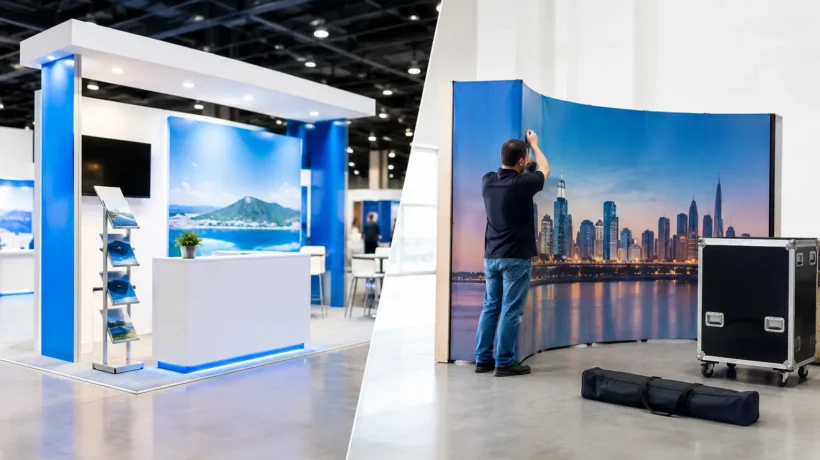
A 20-by-20 booth can create a commanding presence on the show floor. It can also become an expensive asset sitting in storage, waiting for its next appearance. That is the real question behind exhibit rental versus ownership: not simply which option costs less, but which one gives your team the right level of creative freedom, operational control, and financial flexibility.
For some organizations, owning an exhibit is a smart investment that creates consistency across an active event calendar. For others, a rental program delivers the polished, tailored environment they need without tying up capital or adding another set of assets to manage. The strongest choice starts with how your business exhibits, where it is headed, and what your internal team has the capacity to handle.
Exhibit Rental Versus Ownership Starts With Your Event Strategy
The purchase price of an exhibit is visible. The less obvious costs and advantages emerge over time: freight, storage, refurbishment, installation labor, graphics updates, staffing requirements, and the opportunity cost of using the same environment repeatedly.
Before comparing line items, consider the role events play in your sales and marketing strategy. A company exhibiting at two regional events this year has very different needs from a company traveling to eight national shows, supporting product launches, and hosting customer meetings in its booth. Frequency matters, but it is not the only factor. Brand evolution, footprint changes, campaign variety, and internal bandwidth all shape the right decision.
A useful starting point is to ask whether your exhibit needs to function as a long-term platform or as a focused campaign environment. Ownership favors durable platforms. Rentals often favor adaptability.
When Exhibit Ownership Creates Value
Ownership is typically a strong fit for organizations with a consistent, high-volume trade show schedule. If the same exhibit structure will appear at several events each year, the initial investment can be spread across more uses. Over multiple seasons, that can make the cost per event more predictable than repeated rentals.
A custom-owned exhibit also offers the greatest degree of control. Its architecture, materials, storage solutions, demo areas, meeting spaces, and brand moments can be developed around your exact requirements. Rather than adapting your program to available inventory, you are building an environment designed to support the conversations you want to have.
That level of ownership can be especially valuable when your brand benefits from a recognizable visual signature. A distinctive overhead element, product theater, hospitality bar, or meeting suite can become familiar to customers and sales teams alike. Consistency helps create recognition, particularly when your organization has a major presence at the same industry events year after year.
Still, buying an exhibit is not a one-time decision followed by passive use. It requires an asset-management plan. The structure must be stored, inventoried, maintained, packed correctly, and reviewed before each event. Graphics may need to change as products, messages, and leadership priorities change. If your footprint shifts from a 10-by-20 inline booth to a 20-by-20 island, the exhibit must either flex or be redesigned.
Ownership works best when an organization is prepared to manage the asset itself or has a trusted partner managing logistics, storage, maintenance, and deployment. Without that operational foundation, a valuable exhibit can quickly become a burden.
Ownership may be the right choice when:
Your organization exhibits frequently, maintains a relatively stable footprint, and needs a distinct branded environment that can perform across multiple years. It is also a practical path when you have a reliable plan for storage, shipping coordination, installation, and ongoing graphic updates.
When an Exhibit Rental Is the Smarter Move
Rentals are often misunderstood as a compromise. A well-designed rental exhibit is not a generic backdrop with a logo attached. It can be a tailored environment that brings together architectural components, branded graphics, lighting, technology, furniture, and functional spaces around a specific show objective.
For occasional exhibitors, the financial case is straightforward. Renting avoids a large upfront capital expense and eliminates the need to store a structure between events. That can preserve budget for the things that make a measurable difference at the show: pre-event promotion, stronger graphics, product demonstrations, lead capture, hospitality, and trained booth staff.
The strategic case is just as compelling. Rental programs make it easier to change scale and experience from one event to the next. A 10-by-10 presence at a regional conference may call for a concise message and quick conversations. A major industry show may require a theater, private meeting space, and a more immersive product story. Renting allows the physical environment to match the moment.
This flexibility matters for companies entering a new market, testing an event series, rebranding, or launching a product category that may reshape their exhibit requirements. It also helps teams dealing with compressed timelines. When the right components are available and supported by experienced project management, a rental can move from concept to show floor without the lead time required for a fully custom build.
Rentals do have trade-offs. Your design needs to work within available systems and production timing. A highly specialized feature may cost more to create for a short-term use, and preferred components can be limited during busy show seasons. The answer is not to settle for what is available. It is to begin with the experience your audience needs and develop a rental solution that serves it intelligently.
Rental may be the right choice when:
You exhibit once or twice a year, your booth size changes often, your messaging is in motion, or your team wants high-impact execution without taking on long-term asset responsibilities. It is also a practical option when you want to test a new exhibit concept before committing to ownership.
Compare the Full Cost, Not Just the Build Price
The most reliable comparison looks beyond rental fees and purchase prices. A purchased exhibit may deliver a favorable cost per use over time, but only after accounting for the expenses that follow it. A rental may cost more per event on paper, yet reduce storage charges, maintenance needs, and internal coordination.
Ask for a multiyear view that includes design, production, graphics, shipping, drayage, installation and dismantle, storage, refurbishment, and project management. If you expect to exhibit at several shows, map likely booth sizes and locations rather than assuming every event will use the same footprint.
Also consider the cost of a missed opportunity. A booth that does not support demonstrations, private conversations, or clear product education can underperform no matter how efficiently it was purchased. The environment should help your team attract the right visitors and move them toward a meaningful next step.
The Hybrid Approach Often Makes the Most Sense
Exhibit programs do not have to be entirely rented or entirely owned. Many experienced exhibitors use a hybrid strategy. They own the high-value pieces that define their presence, such as custom branded architecture, counters, product displays, or signature structures. Then they rent supporting components when a larger footprint, different layout, or special event calls for it.
This approach can protect brand consistency while limiting the inventory your organization has to maintain. It also gives marketing teams more room to respond to changing event goals. An owned exhibit can anchor the program, while rented elements help it expand, contract, or take on a different character for a specific audience.
For example, a technology company might own a core demo environment and branded storage counter for recurring shows. At its largest annual event, it could add rented meeting rooms, a presentation area, and hospitality furniture. The result feels intentional rather than pieced together because every element is guided by one concept and one brand story.
Choose Based on What Your Team Needs to Accomplish
The best decision is not the one that produces the lowest number on a single estimate. It is the one that gives your team the right environment to meet its event objectives with confidence.
If your priority is long-term consistency and repeated use, ownership may provide the right foundation. If your priority is flexibility, speed, or minimizing administrative burden, a rental program may deliver more value. If your calendar includes both recurring shows and one-off opportunities, a hybrid plan may offer the strongest balance.
At FrontLine Exhibits, the starting point is the same in every case: understand the audience, the event, the operational requirements, and the business outcome behind the booth. From there, strategically applied imagination can turn a square footage decision into a physical environment that earns attention and supports better conversations.