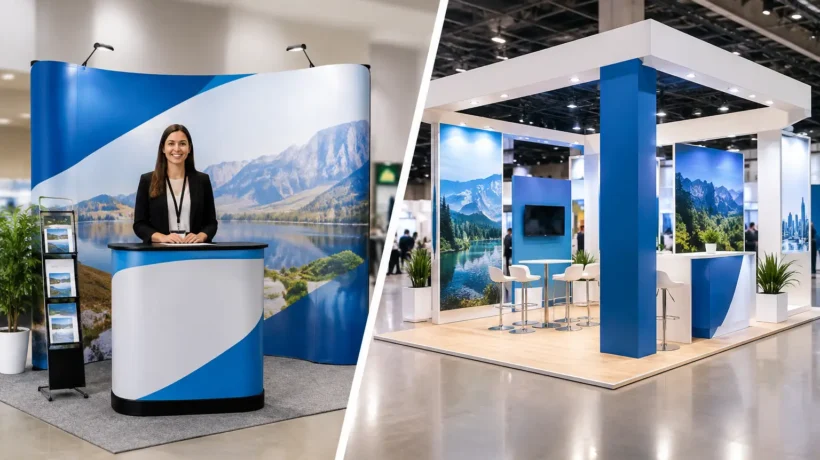
A 10-by-10 space near the aisle and a 20-by-20 island on the show floor can both create meaningful sales conversations. They simply ask different things of your budget, team, timeline, and brand. When weighing portable displays vs island booths, the best choice is not the one with the largest footprint. It is the environment that gives your audience a clear reason to stop, engage, and remember you – without creating an operational burden your team cannot sustain.
For many exhibitors, the decision arrives after a familiar pressure point: a major event is approaching, exhibit costs are climbing, and the existing booth no longer reflects the quality of the business. The answer may be a portable display, an island booth, or a planned progression between the two. The right path starts with the job the exhibit needs to do.
Start With the Experience You Need to Create
Trade show space is a business tool, not just a real estate purchase. Before comparing structures, define what success looks like at this particular event. Are you introducing a complex product that needs live demonstrations? Building credibility in a crowded category? Scheduling private conversations with high-value prospects? Or giving a field team a polished, repeatable presence across several regional shows?
A portable display is often the smarter answer when speed, flexibility, and efficient reuse matter most. An island booth becomes more compelling when the event is strategically important enough to justify an immersive, multi-directional brand environment.
This distinction matters because a booth can look impressive and still fail its commercial purpose. A large exhibit with no defined visitor flow can leave salespeople standing in open space, while a compact display with strong graphics, a clear message, and a confident conversation area can outperform its footprint. Design should support behavior: where attendees notice the brand, how they enter, what they do next, and how the team captures the opportunity.
Portable Displays vs Island Booths: The Core Differences
Portable displays are built for adaptability. Depending on the system, they may include modular frames, fabric graphics, backwalls, counters, monitor mounts, lightboxes, and storage components. They can be reconfigured for different booth sizes and are generally easier to ship, install, store, and refresh than a custom island exhibit.
Island booths occupy space that is open on all four sides. Usually placed in larger floor plans, they create an opportunity to build a destination rather than a backdrop. They may incorporate elevated architecture, demonstration stations, meeting rooms, overhead elements, hospitality areas, integrated technology, and substantial branded graphics.
Neither format is automatically better. The important differences are in the scale of the story you can tell and the management required to tell it well.
Visibility and Brand Presence
An island booth has a built-in advantage in visibility because attendees can approach it from every direction. Height, lighting, architecture, and overhead signage can extend that advantage across a busy hall, assuming show regulations and budget allow for them. For a product launch, a flagship industry event, or a brand that must compete with established category leaders, that presence can be worth the investment.
Portable displays have less physical reach, but they can still command attention. A well-composed backwall, purposeful lighting, concise messaging, and a product experience that is easy to understand can make a 10-by-10 or 10-by-20 feel focused rather than limited. The key is restraint. Trying to make a compact space communicate every product, service, and proof point usually creates visual noise.
Budget Beyond the Exhibit Price
The purchase or rental price is only one part of the decision. Portable displays usually lower the cost of freight, drayage, installation and dismantle labor, storage, and replacement graphics. Their lighter components can also make it easier for internal teams to handle portions of setup, although that does not mean every event should be managed without professional support.
Island booths require a broader budget view. Custom fabrication, larger graphics packages, flooring, electrical, furnishings, technology, rigging, labor, freight, and show services all add up. They can also require more advance planning to avoid rush charges and coordinate details correctly. That investment is justified when the booth supports a high-value event strategy, but it should be measured against expected outcomes rather than treated as a visual upgrade alone.
A rental can change the equation for both formats. It allows an organization to create a premium environment for an important event without committing capital to an asset that may not suit next year’s floor plan or campaign. For infrequent exhibitors, this can be an especially practical way to create impact while preserving flexibility.
Logistics and Internal Workload
Portable systems reduce complexity, not responsibility. Someone still needs to manage graphics, shipping deadlines, show forms, storage, setup instructions, lead capture, and the return journey after the event. The advantage is that there are fewer moving pieces and greater repeatability from show to show.
An island booth introduces more dependencies. Multiple vendors and services must align, and every detail affects the attendee experience – from electrical placement and internet access to cleaning schedules and meeting-room furniture. A missing component or late graphic is more visible in a larger environment. Experienced project management protects the concept by making sure execution holds up under show-site conditions.
For teams with limited event bandwidth, the question is not simply, “Can we operate an island booth?” It is, “Who will own the details while our marketing and sales teams focus on the people in front of them?” Turnkey coordination and asset management can make either choice more manageable, particularly for organizations running a multi-event program.
When a Portable Display Is the Better Strategic Choice
Choose a portable display when your event calendar includes several smaller or changing footprint shows, when your brand needs a consistent presence across territories, or when fast deployment matters. It is also a strong choice for companies refining their event message. A modular setup lets you test graphics, audience responses, product demonstrations, and staffing models before making a larger capital commitment.
Portable does not have to mean generic. Tailored graphics, an intentional floor plan, branded counters, product displays, and selected digital elements can create an environment that feels considered and credible. The best compact exhibits make one promise clearly, then give attendees a simple path to learn more.
This approach works particularly well when sales conversations happen on the show floor, product samples are compact, and the primary objective is qualified lead generation rather than extended hosting. It also leaves more of the budget available for pre-show promotion, trained booth staff, demonstrations, and follow-up – all of which influence return on investment.
When an Island Booth Earns Its Space
An island booth is a strong fit when the exhibit itself must carry a larger portion of the brand experience. That may mean demonstrating equipment, hosting scheduled meetings, presenting multiple solutions to different audiences, or creating a setting that signals category leadership. It can also make sense when competitors are investing heavily and a smaller footprint would make your brand difficult to find or take seriously.
The strongest islands are designed around zones with a purpose. A visitor should be able to recognize the brand from a distance, understand the core offering at the edge of the space, engage with a demonstration or specialist, and move into a more private conversation when appropriate. Open sides should feel inviting, not exposed.
More space also requires stronger discipline. Avoid filling every square foot with messaging, furniture, and technology. Open sightlines, adequate staffing, and room for natural movement are part of the experience. An island booth that feels calm and organized often communicates more confidence than one that tries to entertain everyone at once.
Plan for the Exhibit You Will Need Next
The most productive exhibit strategies are rarely one-time decisions. A company may use portable displays for regional events, rent a larger environment for a major launch, and build a custom island for the annual show where its market gathers. These formats can work together when their design language, messaging, and operational plan are aligned.
Think about the lifespan of every component. Can graphics be refreshed as your campaign changes? Can counters, monitors, and product displays move between footprints? Will the booth fit the venues you expect to attend over the next two to three years? Asking these questions early helps prevent an attractive exhibit from becoming a costly storage problem.
At FrontLine Exhibits, Strategically Applied Imagination means connecting those practical requirements to an environment people want to enter. The goal is not to push every client toward a larger build. It is to create a presence that fits the event, supports the team, and gives the brand room to do its best work.
Your next booth decision should leave your team with more than a floor plan. It should give them a workable platform for better conversations, clearer brand recognition, and a show-day experience they can execute with confidence.