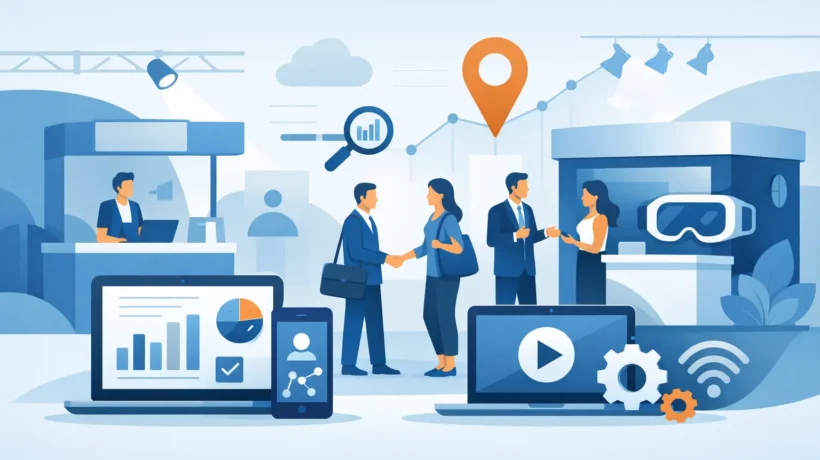
A crowded trade show floor gives brands only seconds to earn attention and only minutes to create a worthwhile sales conversation. Event technology can help teams make those moments more intentional, from capturing lead details accurately to giving representatives the context they need to follow up with purpose. But technology is not a substitute for a compelling environment or a well-prepared team. It works best when it supports the experience your booth is designed to deliver.
For marketing and event teams, the practical question is not, “What new tools should we add?” It is, “What information and interactions will help us create better conversations, reduce staff workload, and prove the event’s value?” That distinction keeps technology focused on business outcomes rather than novelty.
Event Technology Should Serve the Visitor Journey
The most effective trade show technology fits naturally into the path a visitor takes through your space. A prospect may first notice a large-format visual, step closer because of a demonstration, speak with a representative, and then agree to share contact information. Each stage presents a different opportunity to make the experience clearer, more useful, or easier to measure.
Start with the visitor journey before selecting a platform. If your primary goal is qualified lead generation, fast and reliable lead capture may matter more than an elaborate interactive display. If your goal is to explain a complex product, a touchscreen configurator, product comparison tool, or guided video presentation could help representatives tell a more tailored story. For a brand awareness campaign, visual content, social amplification, and meaningful engagement metrics may take priority.
The right mix depends on what your audience needs to do. A senior buyer looking for a quick answer may not want to navigate a tablet experience. A technical evaluator may appreciate the chance to explore specifications before speaking with an expert. Good event technology respects both situations and gives booth staff an easy way to step in when a conversation is ready to begin.
Build a Better Lead Capture Process
Lead retrieval remains one of the highest-value applications of event technology, but scanning a badge alone rarely produces a useful sales lead. A list of names without context creates a familiar post-show problem: the sales team receives contacts but has little indication of what was discussed, what the visitor needs, or how quickly to respond.
A stronger approach pairs badge scanning with a short qualification process. Representatives should be able to select a visitor’s interests, buying timeframe, product focus, and next step without interrupting the conversation. Brief notes are equally valuable. “Needs a proposal before Q4 planning” gives a follow-up owner far more direction than a scanned contact record.
Keep the form short enough to use on a busy show floor. If staff must complete too many fields, they will skip them when traffic increases. Three or four focused questions, supported by clear lead categories, are usually more useful than a lengthy digital questionnaire. Agree on definitions in advance as well. A sales-ready opportunity, a future prospect, and a general inquiry should not all receive the same follow-up treatment.
Speed matters after the event. Ideally, qualified leads should move into the company’s CRM or sales workflow quickly, with ownership and timing assigned before enthusiasm fades. Confirm how that transfer will happen before the show opens. Some event platforms integrate directly with CRM systems, while others require an export, cleanup, or manual import. The more manual the process, the more likely valuable information will be delayed or lost.
Use Interactivity With a Clear Purpose
Interactive technology earns its place when it helps visitors understand, compare, create, or participate. It should not become a traffic-stopping distraction that leaves attendees entertained but unclear about your company.
For example, a product selector can help visitors identify the right solution based on their needs and give sales representatives a useful starting point. A touchscreen presentation can make a large product portfolio easier to explore in a compact exhibit footprint. A live product demonstration supported by digital content can show real-world performance while keeping the presenter in control of the narrative.
Gamification can also work, particularly when the audience is broad and the objective includes drawing people into the space. The trade-off is that an activity must connect back to the brand. A giveaway game may increase scans, but it can also attract visitors who have no interest in your offer. If the experience includes a challenge, quiz, or prize, use it to reinforce product knowledge, customer pain points, or a meaningful campaign theme.
Physical design remains essential. Screens need appropriate sightlines, power, network access, and a place where visitors can interact without blocking the entrance or crowding a conversation area. A technology plan that looks impressive in a presentation can create friction on the show floor if its placement is not considered alongside traffic flow, storage, staffing, and exhibit structure.
Plan for the Operational Details Behind the Screen
Every digital element introduces requirements that need to be managed early. Venue internet may be expensive, unreliable, or unnecessary depending on the application. If a lead capture tool, demo, or presentation depends on connectivity, identify a backup plan. A dedicated connection, offline mode, local content, or hotspot may be appropriate, but each has limitations that should be tested before move-in.
Power is another common detail that affects both cost and design. Determine the wattage requirements for displays, charging stations, computers, lighting, and any specialized equipment. Then map where power will enter the booth and how cables will be concealed safely. These choices are easier and less expensive to address during exhibit development than during installation.
Content management deserves the same discipline. Confirm screen dimensions, orientation, file formats, playback settings, and who has authority to make changes. A looping video with outdated messaging or a tablet loaded with an old product deck can undermine an otherwise polished presence. Assign one owner to approve final content and create a simple pre-show checklist for every device.
FrontLine Exhibits approaches these details as part of the environment, not as an afterthought. Technology, graphics, furniture, lighting, and logistics need to work together so the team can focus on visitors rather than troubleshooting equipment.
Measure What Happened, Not Just What Was Collected
The most useful event metrics connect activity to the objective set before the show. Lead volume is a reasonable measure for some programs, but it does not tell the full story. A booth that collects fewer leads may still produce more qualified opportunities, more scheduled meetings, or more productive conversations with target accounts.
Establish a small set of measures that your team can actually act on. These may include qualified leads, meetings held, demonstration attendance, content interactions, follow-up completion rates, pipeline created, or opportunities influenced. If the event is part of an account-based marketing effort, track engagement from priority companies rather than treating every badge scan as equal.
Technology can add valuable behavioral data, but interpret it carefully. A visitor who spends three minutes with a digital experience may be highly interested, or they may simply be waiting for a colleague. Pair interaction data with staff observations and lead notes to build a more credible picture of intent.
Schedule a post-show review while the experience is still fresh. Ask where visitors paused, which demonstrations drew questions, whether lead capture fields were practical, and where staff encountered delays. Those observations can improve the next event as much as the final lead report. Over time, this feedback helps teams invest in the tools and exhibit elements that genuinely improve performance.
Choose Technology That Your Team Can Support
A sophisticated platform is only valuable if your staff can use it confidently under event conditions. Training should cover more than button-clicking. Representatives need to know why they are collecting specific information, how to introduce an interactive experience without sounding scripted, and what to do when a device or connection fails.
Keep a simple backup kit on site: charging cables, power adapters, a printed version of key talking points, paper lead forms if appropriate, and contact information for technical support. This is not a sign that the plan lacks confidence. It is a practical safeguard for a high-visibility environment where there is little time to recover from avoidable problems.
The strongest event technology often feels almost invisible to the visitor. It helps the right person find the right message, gives your team useful context, and turns a promising conversation into an organized next step. When the tools are chosen around the experience rather than added for spectacle, your exhibit can work harder long after the show floor closes.