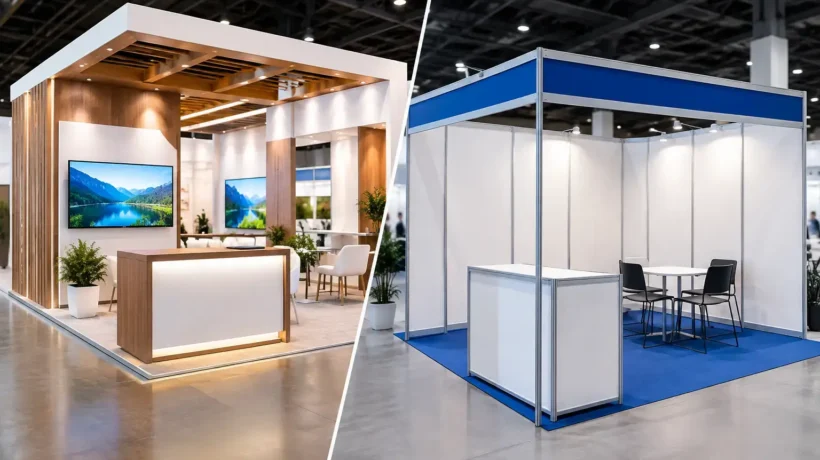
A 20-by-20 footprint can create very different outcomes depending on what occupies it. In the decision between custom exhibits versus rental booths, the better choice is rarely the one with the lowest starting price or the flashiest rendering. It is the option that supports your event goals, respects your timeline, and gives your team a credible, workable place to start conversations.
For some organizations, ownership creates a repeatable platform for a demanding show schedule. For others, a rental brings premium presence without tying up capital in an asset that may only be used once or twice. The right answer comes from looking beyond the booth itself to the full program around it: audience, messaging, shipping, storage, labor, internal bandwidth, and what success needs to look like on the show floor.
Custom Exhibits Versus Rental Booths: The Core Difference
A custom exhibit is designed and built for your organization to own. It can be engineered around your brand architecture, product demonstrations, hospitality needs, lead capture process, and long-term event calendar. While custom does not have to mean oversized or complicated, it does mean the environment begins with your requirements rather than a pre-existing inventory.
A rental booth uses a flexible structure and furnishings that are supplied for a specific event or campaign. Rentals range from straightforward modular displays to highly tailored environments with custom graphics, architectural features, lighting, technology, and branded engagement zones. A well-designed rental should not feel generic. It should feel intentional, even when the core components return to inventory after the event.
Ownership and rental are not opposites in terms of quality. Both can create a polished, high-impact presence. The distinction is primarily about how much permanence, flexibility, and operational responsibility your program requires.
When a Custom Exhibit Makes Business Sense
A custom exhibit often earns its place when exhibiting is a recurring part of sales and marketing. If your organization attends several major events each year with a consistent footprint, owning key structural elements can improve continuity and reduce repeated design work over time.
Your Brand Needs a Distinctive Physical Experience
Some brands cannot communicate their value through a back wall and a few product graphics. A complex solution, a premium service, a hands-on demonstration, or an immersive story may need a space that directs traffic, creates privacy, and gives sales teams room to work. Custom design allows the physical environment to reinforce the way your business wants to be perceived.
That might include integrated demo stations, meeting areas, display cases, secure storage, elevated signage, or deliberate sightlines that help visitors understand where to enter and what to do next. The goal is not decoration. It is a branded setting that makes productive conversations easier.
Your Event Program Is Predictable
Custom ownership is most compelling when you can forecast usage. A booth that appears at six or eight events per year has more opportunity to deliver value than one used every few years. Reuse can spread the initial investment across a broader schedule, particularly when the exhibit is designed for different configurations and maintained between events.
Predictability also helps with planning. Your team knows the footprint, the setup needs, the shipping dimensions, and the attendee experience. That consistency can support better training, more reliable budgeting, and a stronger visual presence from city to city.
You Need Long-Term Control
With ownership comes control over the asset. You can update graphics, add modules, reconfigure layouts, and plan extensions for future campaigns. The trade-off is that you also assume responsibility for warehousing, inventory, maintenance, shipping coordination, and eventual refreshes.
Managed exhibit services can reduce that burden substantially, but it should still be part of the investment discussion. A custom exhibit is not simply a purchase. It is a working marketing asset with a lifecycle.
Where Rental Booths Create an Advantage
A rental is often the smarter strategic choice for infrequent exhibitors, new event programs, or teams facing a major deadline. It provides access to professionally designed structures and finishes while keeping the commitment aligned with a specific event or campaign.
You Need an Impressive Presence Without Long-Term Ownership
A first appearance at an industry show can carry high stakes. You may need a refined environment to meet prospects, introduce a new product, or support a leadership team, but there may be little reason to own a large exhibit afterward. A rental can give the event the visual authority it deserves without requiring a storage plan for the next several years.
This is especially useful when the future event calendar is uncertain. Rather than buying based on assumptions, you can learn what audiences respond to, how your team uses the space, and whether the show merits a larger commitment.
Your Needs Change From Show to Show
A 10-by-20 exhibit for a regional event may not serve the same purpose as a 30-by-30 space at a national conference. Rental inventory allows the environment to change with the opportunity. One event may need product demos and a theater presentation. Another may call for a compact meeting-focused setting with clean graphics and strong overhead visibility.
That flexibility helps organizations avoid forcing every event into the same format. It also gives marketing teams room to test new concepts, campaign messages, and attendee engagement approaches before committing them to a permanent asset.
Your Timeline Is Compressed
Rental does not eliminate the need for planning, but it can reduce production lead time because core structures already exist. When a show opportunity appears quickly, the work can focus on strategic layout, branded graphics, furnishings, and event execution rather than starting every physical component from scratch.
The details still matter. Advance warehouse dates, union labor requirements, venue rules, electrical orders, graphics approvals, and freight deadlines can affect both cost and execution. A rental works best when it is supported by disciplined project management, not treated as a last-minute commodity purchase.
Compare the Full Cost, Not Just the Quote
The purchase price of a custom exhibit can look substantial beside a single-event rental quote. But a meaningful comparison includes every cost required to put the environment to work. Consider design and production, graphic updates, freight, drayage, installation and dismantle labor, storage, repairs, asset management, and internal coordination time.
A rental may have a lower initial cost but can become expensive if you repeatedly rent a similar large-scale environment several times each year. Conversely, a custom exhibit can lose its financial advantage if it sits in storage, no longer reflects the brand, or requires extensive adaptation for each event.
The most useful question is not, “Which option costs less?” Ask, “What will this exhibit cost per successful event over the period we expect to use it?” That shifts the conversation from a one-time expense to a decision about return, relevance, and operational efficiency.
Brand Impact Depends on Design Discipline
There is a common assumption that custom automatically looks better than rental. It can, but only when the design responds to a clear objective. A custom structure with inconsistent messaging or poor visitor flow will not outperform a focused rental that makes the brand easy to recognize and the experience easy to navigate.
Likewise, a rental should not be treated as a logo applied to a standard wall. Strong rental environments use proportion, graphics, lighting, finishes, and furniture to create a coherent story. Visitors should understand who you are, why they should stop, and where the conversation goes next within a few seconds.
Whether you rent or own, protect the elements that shape credibility: clean graphics, confident messaging, functional layout, well-trained staff, and a space that supports rather than distracts from the sales conversation.
A Practical Decision Framework
Start with your exhibit calendar for the next 24 to 36 months. Estimate the number of shows, likely booth sizes, key audiences, and whether your message will remain stable. Then assess how much internal capacity your team has for approvals, logistics, inventory, and onsite coordination.
Custom may be the better fit if you exhibit frequently, need a distinctive and repeatable experience, and can benefit from a long-lived asset. Rental may be the better fit if your schedule is limited, your footprint changes, your program is still being tested, or you want capital available for other marketing priorities.
Many organizations ultimately benefit from a hybrid approach. They own durable branded elements or a core exhibit system, then rent additional components when a larger footprint, a new market, or a special activation calls for more. This preserves consistency without requiring every opportunity to fit the same physical environment.
Build for the Conversation You Want to Have
The booth decision should begin with the business conversation you want to create on the show floor. Do you need to demonstrate a complex product, host private meetings, introduce a new market position, or simply make a stronger first impression? Those requirements should guide the environment before a decision is made about ownership.
Strategically applied imagination is most effective when it is paired with disciplined execution. Choose the format that gives your team the confidence to show up prepared, visible, and ready to make the event matter.