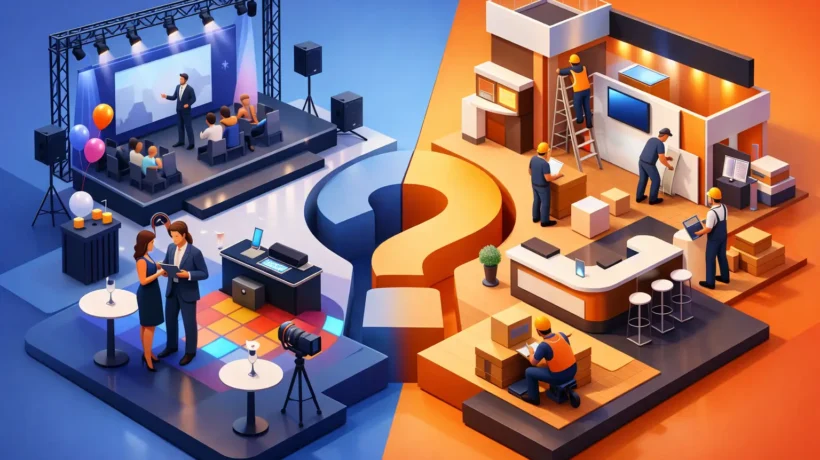
A major event can look flawless from the aisle while hiding dozens of decisions behind the scenes: audience flow, messaging, booth design, freight, staffing, technology, venue rules, and post-event asset storage. That is why the choice between event agencies vs exhibit builders matters. Both can create a strong physical presence, but they typically solve different parts of the event-marketing challenge.
The right partner is not simply the one with the most impressive portfolio. It is the one whose capabilities match the business outcome you need, the workload your internal team can carry, and the level of control required to deliver your brand consistently.
Event Agencies vs Exhibit Builders: The Core Difference
An event agency generally starts with the experience. Its role may include event strategy, theme development, audience engagement, attendee journeys, programming, sponsorships, communications, staffing, and measurement. For a customer conference, product launch, executive meeting, roadshow, or experiential campaign, the agency often serves as the central creative and strategic lead.
An exhibit builder generally starts with the physical environment. Its expertise centers on translating a brand concept into a functional, buildable exhibit or branded space. That can include custom trade show exhibits, rental displays, graphics, fixtures, structures, technology integration, fabrication, installation, dismantle, logistics, and asset management.
There is meaningful overlap. Some event agencies have production teams. Some exhibit builders provide strategic development, project management, and turnkey campaign support. The distinction is not absolute, which is why buyers should look beyond a company label and ask what the partner actually owns from concept through execution.
For trade show programs, the biggest question is often this: Do you need someone to design the complete attendee experience, or do you need someone to create, manage, and support the branded environment where those interactions happen? In many cases, you need both capabilities working in close coordination.
When an Event Agency Is the Better Fit
An event agency can be the right lead partner when the event itself is the product. Consider a national sales meeting, a multi-city consumer activation, or a product launch involving keynote programming, entertainment, guest registration, content production, and hospitality. The physical space matters, but it is one part of a broader experience.
Agencies are particularly valuable when your team needs help defining the event narrative. They can connect a campaign theme to pre-event promotion, stage content, attendee touchpoints, and follow-up communications. If your challenge is making hundreds or thousands of attendees feel a specific emotion, take a particular action, or move through a carefully planned program, an agency’s experience-first lens can be highly useful.
That said, an agency-led model can require close oversight of the physical build. A compelling creative concept still needs to meet venue regulations, fit the footprint, support sales conversations, accommodate product demos, arrive on time, and stay within budget. If exhibit production is outsourced late in the process, the original vision may need costly adjustments.
The best agency relationships account for execution realities early. They bring the exhibit and environment partner into the planning process before creative decisions become fixed.
When an Exhibit Builder Is the Better Fit
An exhibit builder is often the stronger primary partner when your core need is a high-performing branded space, especially at trade shows, conferences, retail activations, and corporate environments. The focus is not just making a booth look polished. It is creating a setting that supports business objectives while functioning under real event conditions.
For example, a 20-by-30 trade show space may need to attract traffic, display products, host demonstrations, provide private meeting areas, accommodate lead capture, and make setup efficient across multiple cities. Those requirements shape the concept from the first sketch. They also affect material choices, storage, shipping, staffing, electrical needs, and whether rental, custom ownership, or a hybrid approach makes financial sense.
A capable exhibit partner brings strategic imagination to those practical details. The result should be a space that feels distinctive without becoming difficult to transport, expensive to maintain, or confusing for visitors to navigate.
This model is especially effective for organizations that exhibit regularly and need consistency across a program. Instead of restarting from scratch for every show, an exhibit builder can manage reusable assets, refresh graphics, adapt layouts to different booth sizes, coordinate logistics, and reduce the internal burden on marketing and event teams.
The Decision Often Comes Down to Ownership
Before selecting a partner, define who will own each major workstream. This is where many event plans become unclear. A proposal may promise a turnkey solution, yet leave critical tasks outside the scope.
Ask whether the partner will lead strategic concept development, create the physical design, produce graphics and structures, coordinate show services, manage freight, install and dismantle the exhibit, train staff, store assets, and support the event calendar after the first show. You may not need one company to do everything. But you do need a clear answer for every responsibility.
A partner that owns the physical environment should be accountable for more than fabrication. If a display arrives with incomplete graphics, a meeting room lacks power, or a rental configuration does not fit the final floor plan, the problem affects the entire event experience. Operational readiness is part of brand presentation.
Likewise, if an event agency is shaping the campaign story, it should provide enough direction for the exhibit environment to reinforce that story rather than compete with it. A beautiful booth and an engaging activation can still feel disconnected if their messages, visual language, and calls to action are not aligned.
Budget: Compare Total Workload, Not Just Line Items
It is tempting to compare quotes by looking at the initial design and fabrication number. That approach can be misleading. The more useful comparison is the total cost of achieving a reliable presence across the life of the program.
Custom ownership may be a smart investment for frequent exhibitors with a stable brand and a repeatable event schedule. A well-designed exhibit can be reconfigured, updated, and used across multiple shows. However, ownership also creates responsibilities for storage, repairs, inventory, refreshes, and logistics.
Rental solutions can be more cost-conscious for infrequent exhibitors, rapidly changing campaigns, or teams testing a new event strategy. Rentals may also provide a premium appearance without committing capital to a structure that will only be used once. The trade-off is less long-term control over every component and potentially higher recurring costs if the same format is used repeatedly.
Event agencies may price around strategy, creative development, staffing, production management, or a percentage of the overall event budget. Exhibit builders may price by design, fabrication, rental components, graphics, labor, shipping, and managed services. Neither structure is inherently better. What matters is whether the scope makes the true cost visible.
Be cautious of a low initial estimate that excludes coordination, show paperwork, freight management, installation supervision, or post-show storage. Those tasks do not disappear because they are omitted from a proposal. They often land on an already stretched internal team.
Evaluate the Partner’s Questions, Not Only Their Answers
The early conversation reveals a great deal. A strategic partner should ask about your audience, sales process, event goals, product mix, booth schedule, internal resources, budget range, and how success will be measured. They should also ask practical questions about venue constraints, deadlines, previous event pain points, and what happens to the assets after the show closes.
If a prospective partner jumps directly to square footage and graphics without understanding your objectives, you may receive an attractive structure that does not solve the real problem. Conversely, a broad creative conversation that ignores floor plans, timelines, and logistics can lead to a concept that is difficult to execute.
Look for a team that can balance both sides. Strategic concepts should be grounded in operational requirements. Production decisions should protect the creative idea and the business goal behind it.
A Better Model: Experience Strategy With Exhibit Execution
For many B2B organizations, the strongest answer is not choosing one category over the other. It is building the right partnership model for the program.
An event agency may lead a high-profile launch or customer event while an exhibit partner designs and manages the physical environments. An internal marketing team may own campaign strategy while an exhibit company supplies the creative development, fabrication, rentals, logistics, and onsite support needed to execute it. For a trade show calendar, an exhibit-focused partner may serve as the central lead, coordinating with outside agencies for promotions, content, and experiential elements.
The key is avoiding gaps between the concept and the show floor. Every branded environment should give visitors a clear reason to stop, engage, and continue the conversation with your team. It should also give your internal team confidence that the details are managed.
The next time a major event appears on the calendar, start with the outcome you need to create, then choose the partner structure that can carry it all the way into the room. A memorable presence is built from imagination, certainly, but also from the disciplined planning that makes that imagination perform.